Summer 2026 works: projects on an unprecedented scale to prepare the network of tomorrow
Why so much work this summer?
The network must be modernised to accommodate new trains and metros, support its extension of more than 200 kilometres and prepare for future interconnections withlines 15, 16, 17 and 18.
Summer is the best time for these operations, with attendance dropping by up to 40%. It makes it possible to carry out major projects while limiting their impact on travel.
After several years of underinvestment, the effort was relaunched in 2016, both for trains, metros and infrastructure. 16 billion euros have been invested in infrastructure for trains and metros.
What was achieved this summer
The work focused on several pieces of equipment essential to the operation of the network.
What is this equipment used for?
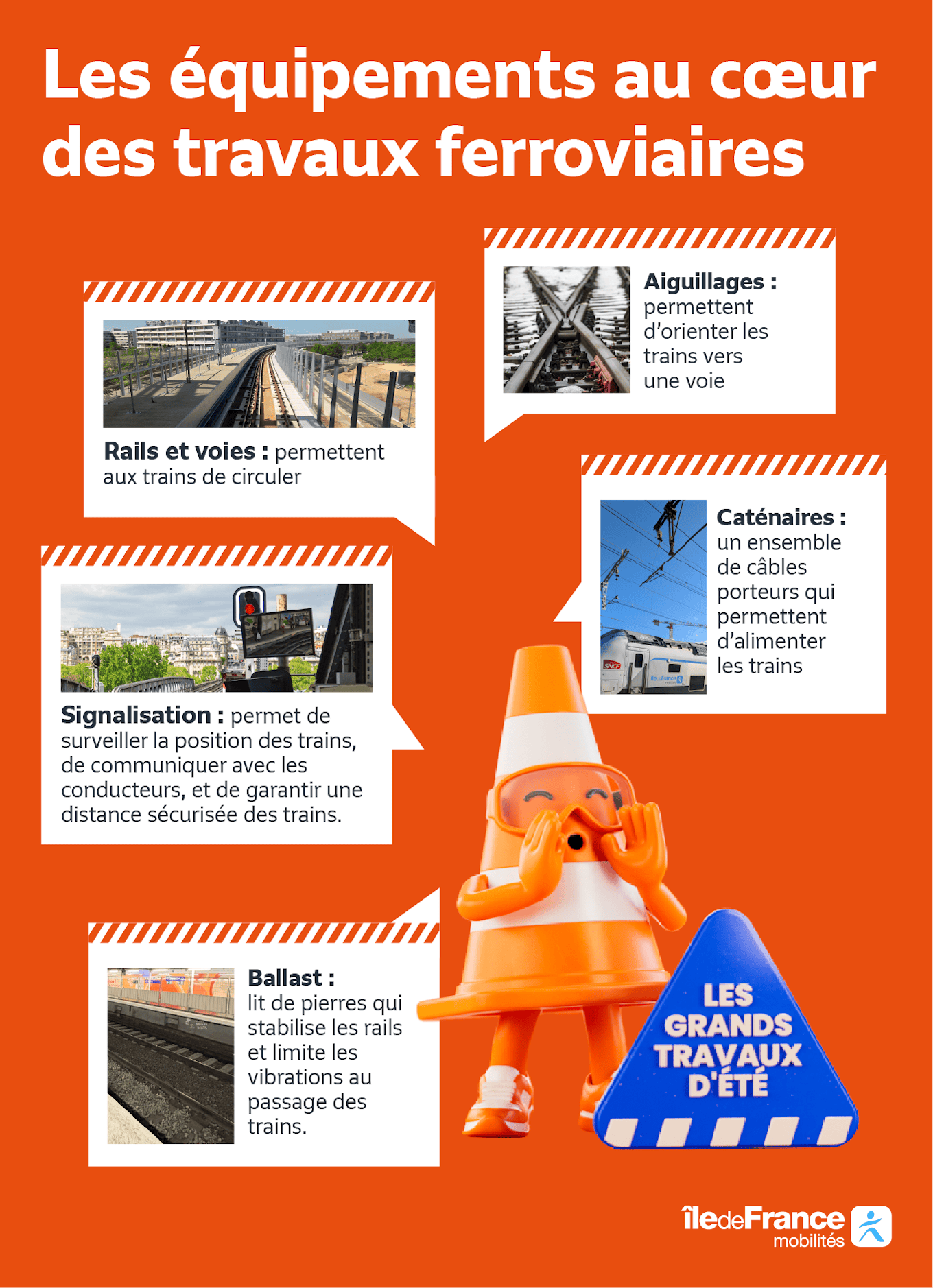
- The rails and tracks allow trains to run. Renewing them limits wear and tear and the risk of incidents.
- Switches are the "crossroads" of the network: they allow trains to change tracks.
- The catenaries supply the trains with electricity. Replacing them helps to limit electrical failures.
- Signalling regulates train traffic and allows traffic to be managed in complete safety.
- Ballast is an aggregate that keeps the rails stable and limits vibrations, for safer and more reliable traffic.
Renewed tracks and switches
More than 25 kilometres of track have been renewed on lines C and P. On the section common to the RER B and D, 40 switches have been replaced between Gare du Nord and Gare de Lyon.
These operations help to limit the wear and tear of the infrastructure, slowdowns and the risk of incidents.
The metro prepares to welcome the MF19
Work has been carried out on lines 8, 12 and 13 to prepare for the arrival of the MF19, the future metro that will gradually replace the old trains on several lines in the Paris region.
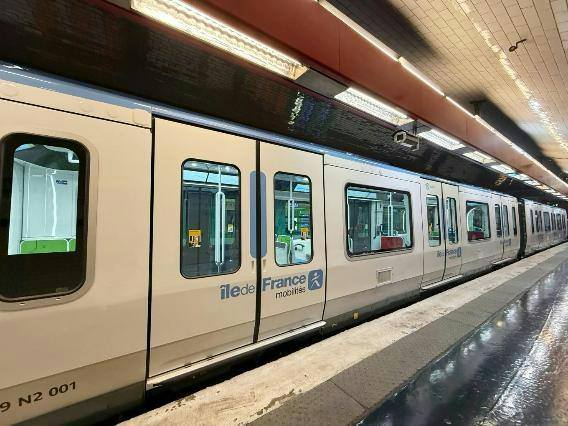
- On line 8, the tracks have been brought up to the MF19 gauge between Balard and Concorde.
- On line 12, the facilities have been modernised between Concorde and Jules Joffrin.
- On line 13, the switches and crossings have been renewed between La Fourche and Saint-Denis Université, in preparation for the arrival of the MF19 and the automation of the line.
The RER trains are being modernised
On the RER B, a dozen projects were carried out at the same time, in particular to replace the Bourg-la-Reine signal box and to renew the tracks and ballast.
On the RER A, the switches and crossings, sleepers and ballast have been renewed between Vincennes and Noisy-le-Grand, in line with the modernisation programme undertaken ten years ago.

Did you know?
RER A: 10 years ago, the line had a punctuality of 80 to 82%. Today, it is 95% for the busiest line in Europe.
Future correspondence is being prepared
In Val-de-Fontenay, an underpass has been built to prepare the connection with the future line 15.
On the RER C, the interconnection work with line 15 has been finalised at Les Grésillons and Issy-les-Moulineaux. The T1 tramway has also been the subject of work to prepare its connection to the future lines 15, 16 and 17.
The network prepares for climatic hazards
On the RER C, about a hundred operations have been carried out, including flood safety work at Les Invalides.
These operations aim to strengthen the resilience of infrastructure to heavy rains, floods and extreme weather events.
The summer works in figures
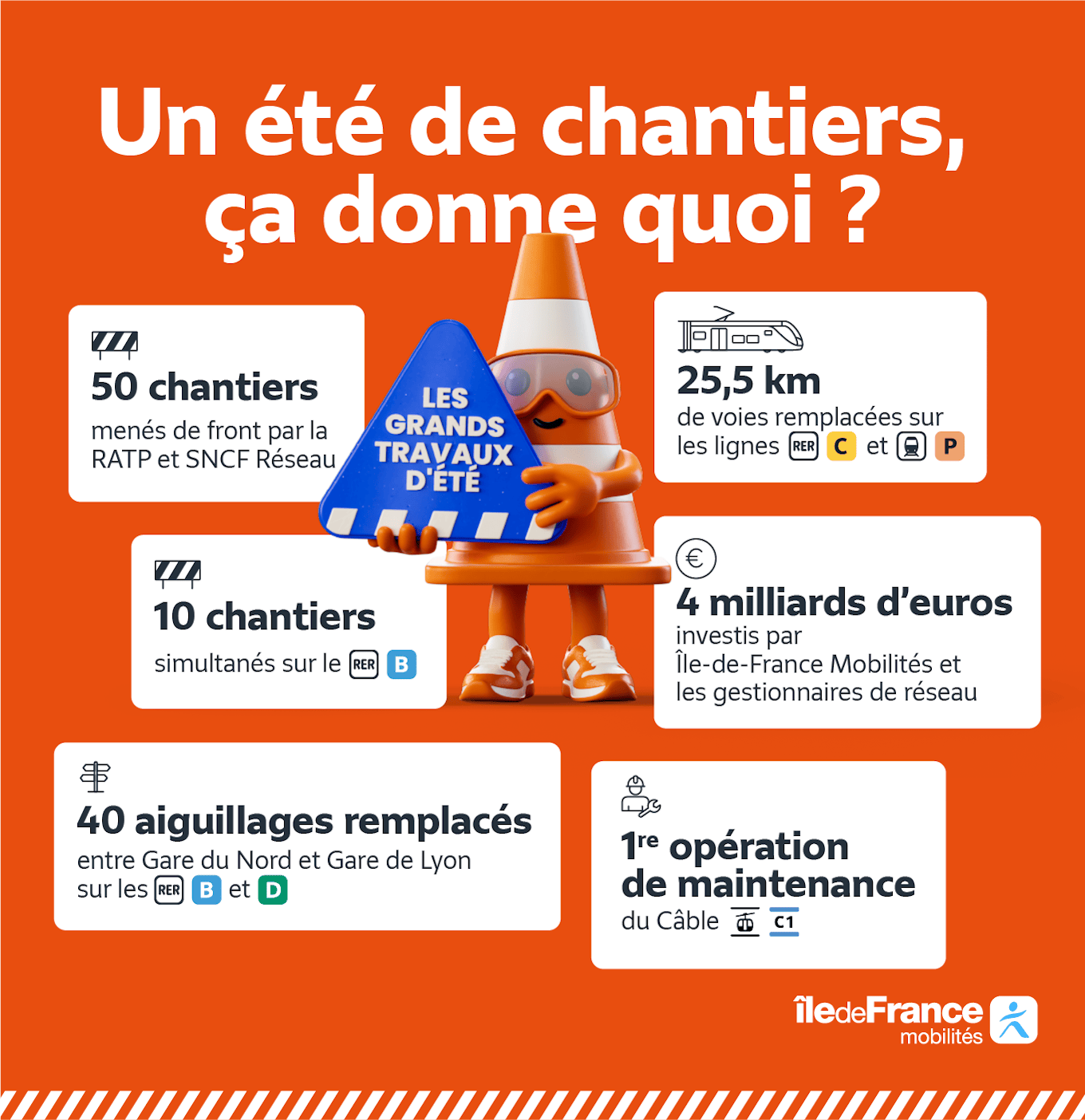
- 50 projects carried out simultaneously by RATP and SNCF Réseau
- 25.5 kilometres of track replaced on lines C and P
- 40 switches replaced between Gare du Nord and Gare de Lyon
- 10 simultaneous construction sites on the RER B
- €4 billion invested this summer by Île-de-France Mobilités and network operators
- 1 first maintenance operation of the C1 Cable
Work for better travel tomorrow
This work has several objectives:
- Reduce the risk of incidents and outages
- improve consistency and punctuality
- make the network more resistant to high heat and bad weather
- Preparing for the arrival of more modern and more capable trains and metros
- Facilitate future connections
- Improve long-term grid reliability
The benefits are not always immediate: some projects are preparing changes that will be felt in several years. But they are essential to build a network that is more reliable, more comfortable and better adapted to the needs of passengers.
What lessons can be learned for future work?
The summer work will continue in the coming years. To better support passengers, however, several points will have to be improved:
- More early information, particularly with local authorities and companies to prevent work and promote alternative solutions
- Better-sized replacement buses, to avoid saturation of regular lines
- Clearer signage, to facilitate access to replacement buses and connections
Key takeaways
Every summer, the drop in ridership makes it possible to carry out essential work on the network: renewing infrastructure, preparing for the arrival of new trains and metros, improving connections and better protecting the lines against climatic hazards. These projects are sometimes restrictive, but essential to move towards a more reliable, modern and comfortable network.