Conclusions of the study conducted on the feasibility of free public transport in Île-de-France, its financing and pricing policy
This concrete and objective work was carried out by a committee of eight independent experts*, under the chairmanship of Jacques Rapoport, former Chairman of SNCF Réseau, former Director General of La Poste and former Deputy Director General of RATP, by collecting contributions from the eight departments of the Ile-de-France region and the local authorities concerned. It will inform the choices made by Île-de-France Mobilités, the organising authority for sustainable mobility, and as such the ticket, the sole decision-maker on transport pricing.
Main conclusions of the committee (summary of the report at the bottom of the page):
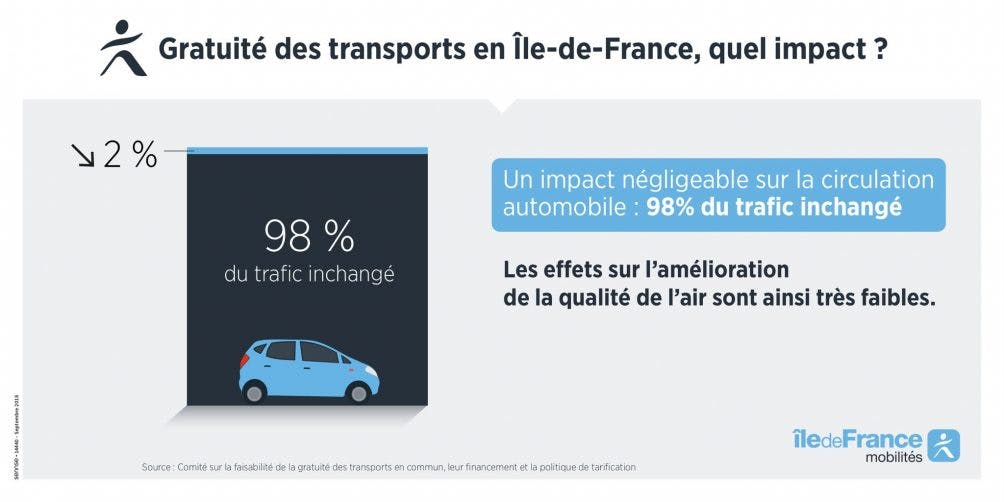
1 – 2% decrease in car traffic: free public transport would have a minimal effect on the reduction of road traffic and the improvement of air quality.
Today, 90% of motorists would take longer by public transport than with their car, the value of which is for the most part much higher than the cost of the Navigo Pass. The remaining 10% chose this mode out of comfort or necessity. Motorists would therefore be very unaware of free public transport, since they have already chosen a much more expensive mode.

What is the impact of free public transport in Île-de-France? A negligible impact on autonomous traffic: 98% of traffic unchanged. The effects on improving air quality are therefore very small.
Journeys that are currently made by walking or cycling will tend to decrease and be transferred to public transport.
Thus, the effects of free public transport on car pollution would be minimal: the reduction in air pollution can be estimated, in socio-economic value, at €28 million per year, a minimal figure compared to the cost of pollution linked to road traffic in Île-de-France, i.e. €4 billion per year. As for the gain in terms of road safety, it is estimated at €24 million per year, compared to an annual socio-economic cost of €2 billion.
2 – + 6 to 10% ridership: free travel would quickly degrade all public transport lines
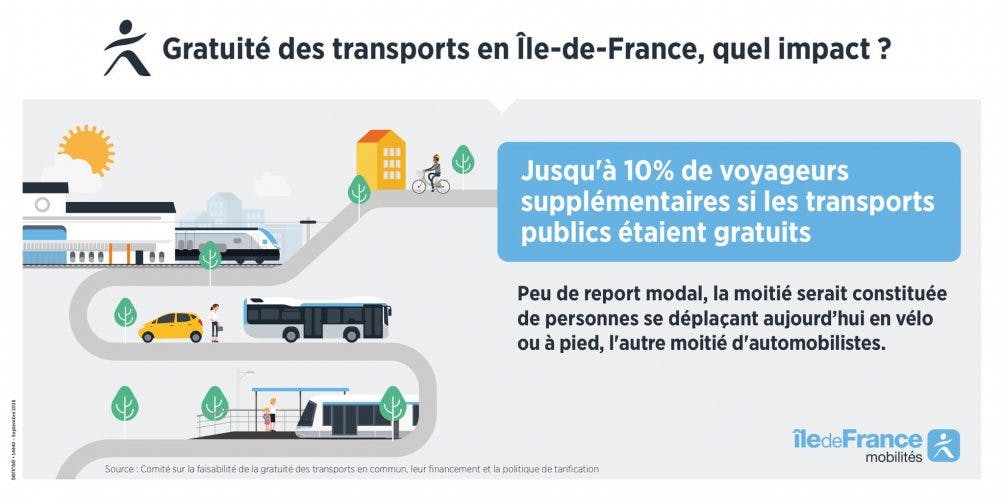
The new flows would have a negative impact on the quality of service of public transport in the Ile-de-France region. Nearly 40% of the postponed flows would correspond to trips during rush hour. In addition, 55% of the deferred flows would correspond to trips from suburb to suburb and 25% to internal travel within Paris.

What is the impact of free public transport? Up to 10% more passengers if public transport was free.
The effects would be marked on the tram and bus networks, particularly in the suburbs, with an increase in flows of more than 20%, implying a deterioration in service for lines already at the limit of capacity and imposing, where possible, a reinforcement of the offer with the corresponding additional costs. On the metro, the increase in traffic, although seemingly moderate (+4%), would occur on lines that are already busy (line 13, line 9, line 1, etc.). In total, for the rail network alone, the socio-economic loss linked to the discomfort for the passenger can be estimated at €130 million.
3 – More than 1 million people already benefit from free or reduced fares.
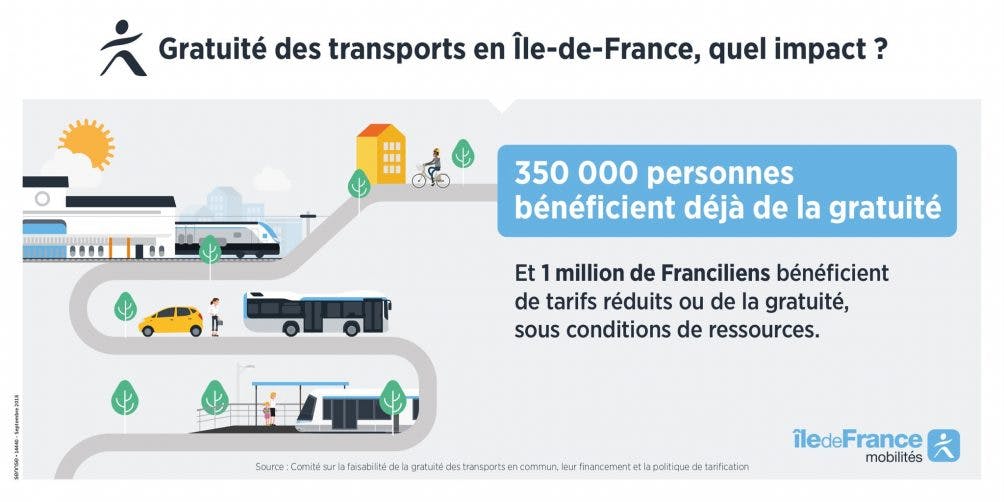
In 2018, more than one million Ile-de-France residents benefit from reduced rates or free subscriptions: 350,000 people (RSA beneficiaries) are completely free; 260,000 people benefit from a 50% means-tested reduction (370,000 from 2019 due to a change in rules); 315,000 elderly or disabled people also benefit from means-tested reductions, up to free (Paris and Val de Marne); Finally, nearly 200,000 young people benefit from subscriptions at a reduced rate.

What is the impact of free public transport? 350,000 people already benefit from free travel and 1 million Ile-de-France residents benefit from reduced rates or free travel, subject to means testing.
The available studies show that, given the existing subsidies and the overall low level of prices, there is little correlation between affordability and unemployment, and that it is always more a question of travel time than of price.
Under these conditions, free travel would not be a measure of social equity, since it would benefit those who can afford the price of public transport as much as the poorest.
4 – €500 tax increase on average per year and per household in the Ile-de-France region.
Passenger contributions amounted to €2.5 billion in 2016. The transition to free travel would therefore require finding €2.5 billion in other revenues, assuming that employers' reimbursements on subscriptions, in the order of €800 million, could be recovered without loss by an increase in the transport payment, which is not a given, i.e. €3.3 billion.

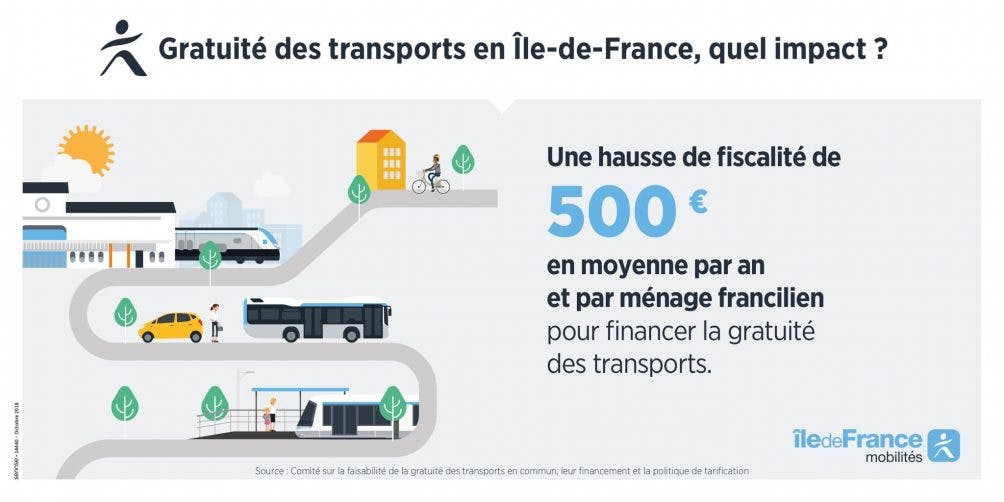
What is the impact of free public transport? A tax increase of 500 euros on average per year and per household in the Ile-de-France region to finance free transport.
No alternative source of financing seems viable to make up for the loss of such an amount, which would represent an increase in taxation of €500 on average per year and per household in the Ile-de-France region, even though it is necessary to spend more each year to increase the supply of transport in order to meet needs: reinforcement of bus supply, extension of tram and metro lines, opening of lines 15, 16, 17 and 18 of the Ile-de-France metro and lines 9, 10, 12 and 13 of the tramway, extension of the RER E, etc.
In the event of an increase in the Transport Payment, paid by employers, the macroeconomic effects would, according to an assessment carried out by the Directorate-General of the Treasury, be recessionary in the medium and long term, with the destruction of 30,000 jobs and the loss of 0.7 points of regional GDP (i.e. just over €4 billion). In the case of urban car tolls, particularly high levels would be needed to achieve such revenues: for example, a cordon toll around Paris, excluding the ring road, amounting to €8 during rush hour and €5 during off-peak hours, would generate less than €400 million in annual revenue. A toll on a wider area and at a higher level would be highly unfair, by weighing heavily on low-income households dependent on the car.
Free transport would therefore carry a significant risk of impoverishment of public transport and a deterioration in the quality of service, as improvements to the offer or even its mere maintenance can no longer be financed.
Committee Members:
· Jacques Rapoport, former Chairman of SNCF Réseau, former Director General of La Poste and former Deputy Director General of RATP, Chairman of the Committee.
· Gilles Carrez, LR MP for Val-de-Marne,
· Gilles Savary, former PS MP for Gironde,
· Alain Quinet, Deputy Chief Executive Officer for SNCF Réseau,
· Marc Pélissier, Secretary General of the Association of Transport Users of Île-De-France (AUT-IDF),
· Yves Crozet, professor at Sciences Po Lyon and the University of Lyon II and former president of the Transport Economics Laboratory (LET)
· Fabien Leurent, Research Director at the City Mobility Transport Laboratory, University of Paris-Est, IFSTARR-ENPC-UPEM,
· Francois Mirabel, President of the Transport Energy and Environment Observatory in conjunction with ADEME, Dean of the Faculty of Economics Director of the SCUIO-IP University of Montpellier
The rapporteurs were Grégoire Marlot, former Chief Strategy Officer for SNCF Réseau and member of the Spinetta Commission, and Carole Gostner, Deputy Head of the European Financial Instruments Office at the Directorate-General of the Treasury.