Île-de-France Mobilités and RATP: a new contract at the service of passengers

The agreement between Île-de-France Mobilités and RATP until the end of 2024 was approved by the Île-de-France Mobilités Board of Directors on 14 April 2021. At the heart of this last commitment before the opening up of the bus network in Paris and the inner suburbs to competition: the quality of service, passenger perception and the modernisation of the network.
Renewed equipment, improved services: investment on the rise
Because a well-functioning transport network is a renovated and innovative network, Île-de-France Mobilités is committed to investing €1.6 billion per year with this new contract. This is 4 times more than in the previous contract. These investments will be used to finance, in particular, the renewal of rolling stock (RER B and T1 tramway in particular), the end of diesel buses and the development of eco-stations, the acceleration of intermodality with the eventual creation of 10,000 bicycle parking spaces, and to improve the conditions for passengers in stations and stations.
FOCUS
Clean shots! €60 million dedicated to station cleanliness is the "Clean Shots" operation. The objective: the rapid upgrading of a dozen stations and the creation of 100 toilets in stations by 2024.
Penalties and incentives: travellers weigh 10 times more
Penalties and financial incentives have been greatly increased around one objective: improving the quality of the service provided. Thus, the bonus/malus envelope is multiplied by 4 to reach €100 million/year, 25% of which will be directly linked to the perception of passengers , in particular on their feelings of cleanliness, on damage (tags) or on care during the works. The weight of passengers in the allocation of bonuses or penalties is therefore multiplied by 10 with a budget of €25 million, compared to €2.5 million in the previous contract.
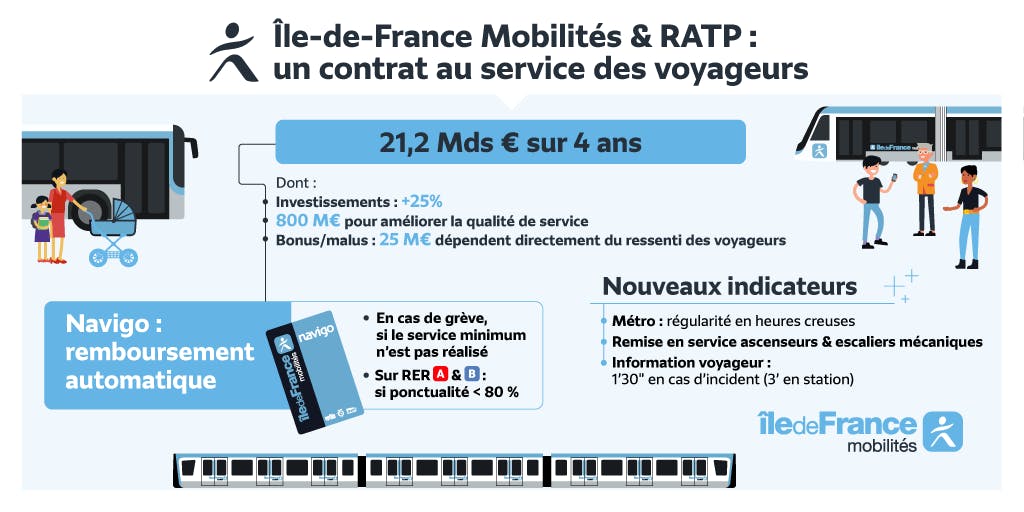
Infographic on the RATP x Île-de-France Mobilités contract
Communication, regularity, safety: indicators for "better travel"
At the heart of the contract with the RATP, performance indicators are associated with financial incentives. The objective: to offer passengers the best experience, throughout their journey.
This year, new indicators are emerging, such as real-time information on the time it takes for lifts or escalators to return to service, regularity at off-peak hours in the metro, safety, driving comfort on board trams and buses, availability of video protection on board metros, etc. RER and trams...
Of all the objectives requested of the RATP, three-quarters have been increased, such as dynamic passenger information on board trains, cleanliness in stations and on trains and the quality of contact with passengers. In addition, in view of the growth in the volume of work on the rail network in the Île-de-France region, a specific system has been requested to monitor and control the quality of passenger care during the works.
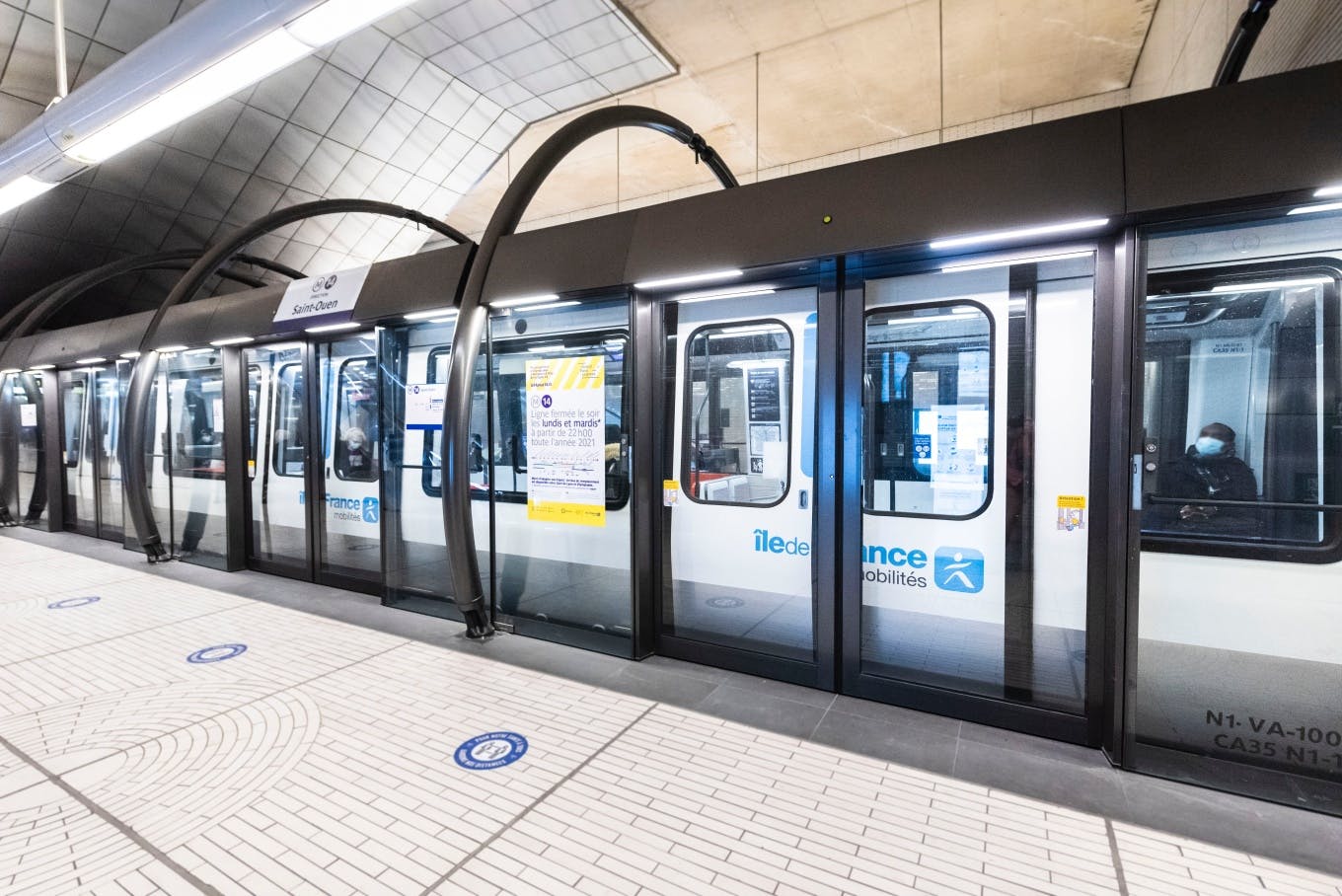
Passenger information: real-time and support
Because passenger information is at the heart of transport missions, investments will make it possible to know in real time the availability of equipment (escalators, elevators, etc.) or the load on board vehicles. The new contract also provides for the development of guidance solutions in indoor spaces, in particular to help people with reduced mobility.
Safe transport
RATP's resources have been strengthened to ensure the safety of passengers: the GPSR staff will be increased (23 additional agents) and the RATP will make greater use of private security (a total of more than 100 agents) in order to offer a full range of security services. Île de France Mobilités is asking the RATP to step up the fight against harassment in transport.
Automatic refunds
As with the contract between Île-de-France Mobilités and the SNCF, this agreement ratifies the automatic reimbursement of subscriptions in the event of a malfunction – in particular in the event of a strike.
On the RER A and B, the calculation of bonuses/maluses is now carried out every week, with objectives by branch and no longer by line. In the metro, this calculation is monthly, with enhanced indicators for automatic and semi-automatic lines.
On the RER, if punctuality is less than 80% during:
- 3 to 5 full months (not necessarily continuous) over the calendar year: reimbursement of half a monthly fee;
- 6 to 9 full months (not necessarily continuous) over the calendar year: reimbursement up to a monthly flat rate;
- more than 9 full months (not necessarily continuous) over the calendar year: reimbursement up to a monthly flat rate and a half.
In the event of a strike, if the minimum service is not provided, reimbursement will be systematic. And for the first time, if the minimum service is not only provided on a metro branch outside Paris, the users concerned will be reimbursed, which was not the case before.