Since 2014, the number of forgotten bags and objects has increased by 122% on the Transilien network with more than 1500 reports per year, or more than 4 per day, thus reinforcing the feeling of insecurity and causing many delays and disruptions.
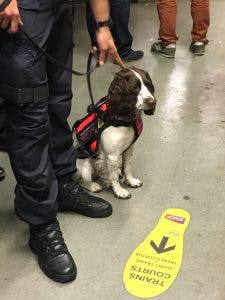
New Dog Detection Teams: Dogs Trained to Detect Explosives
45 to 55 minutes saved for Ile-de-France travellers
An RER line disrupted at rush hour by a suspicious package takes two to three hours to return to normal traffic. SNCF (SNCF Transilien and the National Directorate of Security) have worked, at the request of Ile-de-France Mobilités, on the deployment of 20 dog detection teams composed of a dog handler associated with a dog specially trained to detect explosives.
This system should make it possible to carry out a "search for clues" in 5 to 15 minutes, compared to more than an hour in the absence of such teams, which will increase the efficiency of the SUGE teams and therefore fight more effectively against possible malicious acts.
The deployment objective is to have 20 operational brigades by the end of 2017, 12 are already on the ground. The overall cost of the project is €6 million over 3 years (2017 to 2019) co-financed by Ile-de-France Mobilités and SNCF.

Principles of operation of dog detection teams
The protocol for handling suspicious packages by a canine team and their training have been defined by the Security Department of the Public Railway Group, in conjunction with the public authorities including the Paris Police Prefecture, its Central Laboratory and the General Secretariat for Defence and National Security (SGDSN).
A suspicious package detection experiment similar to the RATP
Since 1 December, RATP has been experimenting with a new procedure for dealing with abandoned objects with the support of two dog teams. The RATP experiences 7 suspicious packages per day, 30% of which are on the RER A operated jointly with the SNCF. This experiment covered, by deploying from the Châtelet hub, 8 RER stations and 32 metro stations. The priority for the RATP was to cover the central section of the RER A.
Depending on the conclusions issued by the RATP to the public authorities, Ile-de-France Mobilités will study the possibility of participating in this security system.