Getting around at night by public transport

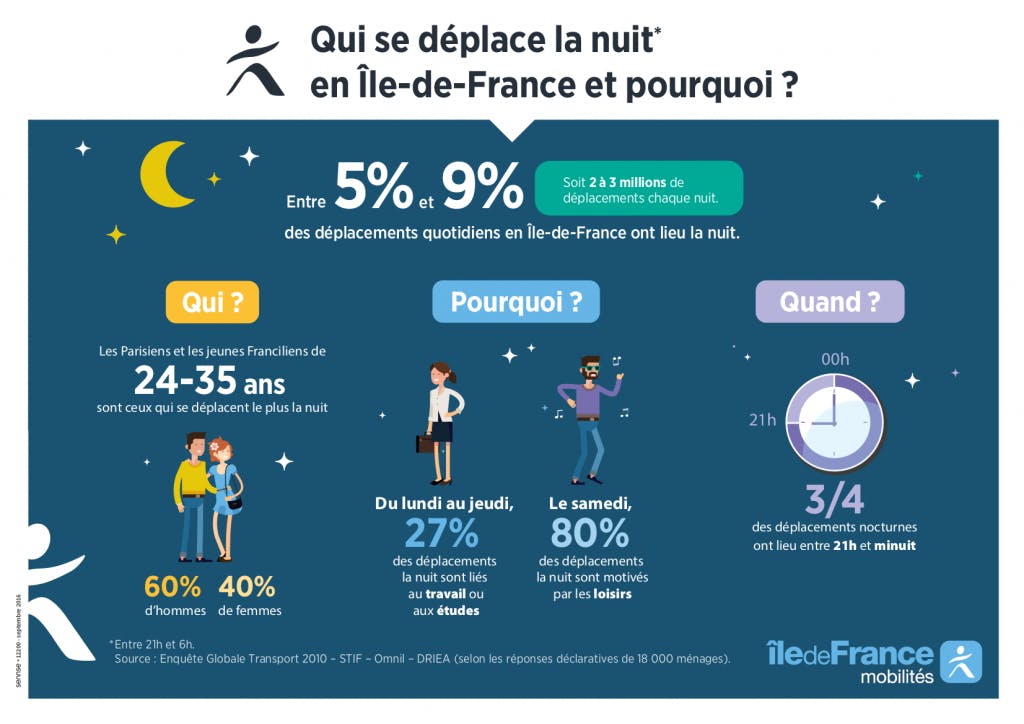
2 to 3 million trips at night in Île-de-France

1.8 million trips are made every night from Monday to Thursday, just over 2 million on Fridays and more than 3 million on Saturdays.

  • Trips at night represent between 5 and 9% of daily trips.
  • During the week, nearly three-quarters of night-time trips are made during the late evening from 9 p.m. to midnight.
  • 60% of them travel at night outside Paris.
  • Leisure: the first reason for travelling at night
  • More leisure-related trips in Paris, related to work in the suburbs
  • Longer journeys at night than during the day (from 6.4 to 7.3 km depending on the night, compared to 4.4 to 5 km on average over a whole day).
  • Trips at night are mostly made by men, except at weekends.
  • More than half of the trips at night are made by car and motorized two-wheeler.
What transport offer at night for Ile-de-France residents?

  • The train-rer and metro lines operate all year round from 5:00 to 01:00 in the morning on weekdays and until 2:00 on Saturdays for the metro.
  • The Ile-de-France night bus network, the Noctilien, now has 48 lines that run from 0:30 a.m. to 5:30 a.m.
  • A night transport offer for New Year's Eve on 31 December, the Fête de la Musique and for certain events such as the UEFA EURO 2016 final.

Prospects for improving the night-time transport offer

This study concludes that the need for public transport by heavy mode (train, metro) is not proven, and makes proposals to improve the night offer by Noctilien, to study public transport by metro at night only on certain specific nights, and to strengthen the articulation between alternative offers and night public transport stops.

Infographic: Night transport in Île-de-France

Infographic: Night transport in Île-de-France. Who travels at night in Île-de-France and why? That? Parisians and Ile-de-France residents aged 24-35 are the ones who travel the most at night. Men 60%, Women 40%. Why from Monday to Thursday 27%, Saturday 80%. When? between 9 p.m. and 00 a.m.

This study is based in part on data collected by OMNIL, the mobility observatory in Île-de-France. This study also sets out several avenues of work to improve night-time travel throughout the Region.