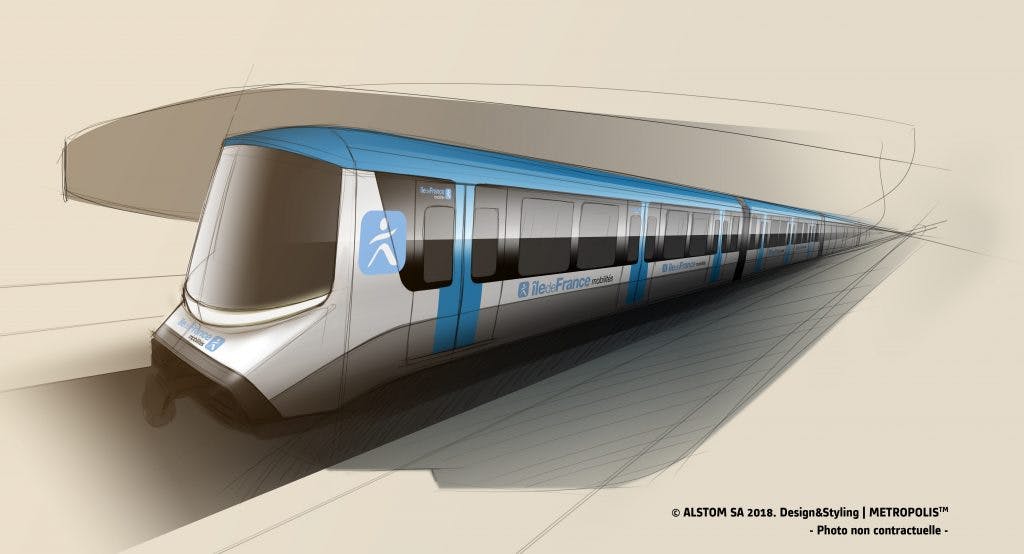
A new experience of travelling by public transport
The new metros on lines 15, 16 and 17 are open along the entire length of the trains, giving passengers a feeling of conviviality, space and comfort. Thanks to the 3 wide doors on each side, they allow great fluidity in the entrances and exits, as well as an easier movement of passengers during the journeys. The equipment has been designed to allow a high level of comfort, thanks in particular to air conditioning, lighting and seats. It will also offer connectivity to passengers, thanks to USB charging sockets for mobile phones. Finally, the end structure will offer a panoramic opening with a wide windscreen.
The new metros on lines 15, 16 and 17 will ensure the highest levels of availability, reliability and safety. Each train will be able to carry up to 500 passengers in the 3-car version (54 metres), and up to 1,000 passengers in the 6-car version (108 metres). Particular attention is paid to optimizing maintenance. The on-board diagnostic system will provide information on the condition of the train's equipment and give maintenance personnel a complete view of the state of the fleet, making it easier to plan corrective and predictive maintenance tasks between two commercial departments.
Several innovations will guarantee the environmental performance of this new equipment, an undeniable asset for the operation. The traction and auxiliary converters will benefit from the latest technologies to ensure that energy consumption is optimized. Particular attention is paid to noise emissions, vibrations and atmospheric emissions. Minimisation of brake particle emissions will be achieved through electric braking up to very low speeds, thus limiting the use of brake discs. In addition, the recovery of braking energy will contribute to the recharging of batteries or to the supply of power to the general electricity grid. Finally, the recyclability rate is more than 96%, and the recovery rate of the train, according to the European standards in force, is more than 98%.
In order to carry out this very important project, a total of 350 Alstom employees in France will work on this project, including 150 experienced engineers. More than 1150 jobs will be secured in France in the French rail sector thanks to this project. Six French sites will design and manufacture this new equipment. The Valenciennes Petite-Forêt site will be in charge of project management, studies, development, production, assembly and validation of the trains. Five other Alstom sites in France will develop and produce the components: Le Creusot for the bogies, Ornans for the engines, Tarbes for the traction systems, Villeurbanne for the on-board electronics and the remote maintenance system and Saint Ouen for the design.