
ExtensionSaint-Denis Porte de Paris > Paris Gare Rosa-Parks

The T8 tram and the environment
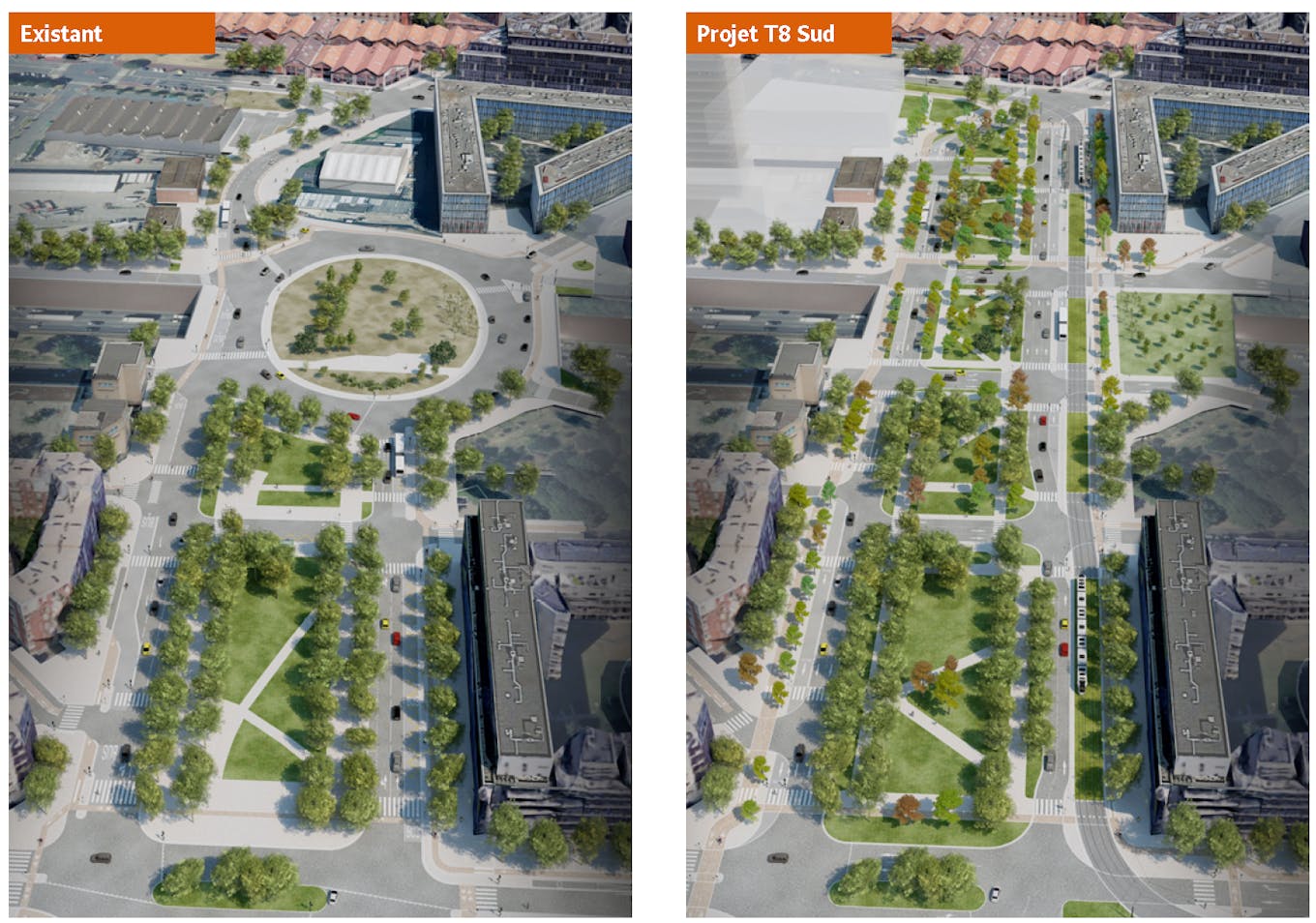
Illustration of the transformation of the Porte d'Aubervilliers and Place Skanderbeg (non-contractual development intention)
Requalifying and greening urban public space
The developments that accompany the future route represent an opportunity to carry out additional work on the public space (greening, de-waterproofing, widening of sidewalks, modernisation of street furniture, etc.). The design of these developments will be the subject of detailed studies in the future, with the aim of creating urban spaces that are more welcoming to all.
Several detailed studies of existing tree heritage have identified more than 800 trees to assess their health and ecological significance. The primary objective is to avoid the removal of trees. However, where this is unavoidable for the needs of the project, trees will be replanted nearby to ensure a positive outcome, in accordance with the regulations. In addition, wood from tree felling will be reused as much as possible within the framework of the project.
At this stage, and despite all optimization efforts, 240 trees have been identified as needing removal. The revegetation plan provides for the planting of about 340 new trees along the streets affected by the tramway extension. Other sites are being studied to complete this compensation system with nearly 400 new trees as close as possible to the route. The final objective is to contribute to expanding the tree network in the territory to strengthen the place of nature in the city.
On the entire route and for the ancillary sites that will host new plantations under the ticket of the T8 South project, it is planned to plant species carefully selected for their ability to embellish the landscape over the seasons, to promote biodiversity and to guarantee the development of trees over the long term.
Improving the management of the urban environment and adapting to the challenges of global warming
The project takes into account environmental quality requirements and seeks to promote sustainable and resilient urban management solutions, whether for waste management, water management or green space management.
To modulate the urban, dense and often very "mineralized" character of the territory, the project will contribute to increasing the semi-permeable surfaces on the entire perimeter of the project, to create islands of freshness by reinforcing vegetation and applying reflective coatings on all the surfaces that lend themselves to it.
Rainwater management and the fight against flooding by rising water tables are one of the major challenges of the project.
Two main types of rainwater management are possible: alternative management solutions that promote rainwater infiltration through soil permeability and through facilities that promote infiltration are preferred, and the discharge of rainwater into the sewerage networks, via gutters, grates and drains, which is necessary in addition to the first system in the event of heavy rainfall.
The detailed studies to come will cover all aspects related to rainwater management (waterproofing, infiltration, storage and shaving, flood risk, etc.) and the project owner will encourage the search for innovative and sustainable solutions for water management.
The technical solutions selected will be submitted to the water police during the pre-project phase as part of a specific environmental authorisation under the ticket of the "Water Act" applying to any project having an impact on groundwater, surface water and aquatic environments. This file will make it possible to precisely define the impact of the project on surface and groundwater, as well as the specific measures to be implemented.