

ExtensionChâteau de Vincennes < > Val de Fontenay
Construction methods
The work will be carried out mainly underground, with the use of a tunnel boring machine; and from the surface (in cut-and-cover where possible) for stations, ancillary structures, and the train breakdown centre. The connection to the rear station of Château de Vincennes will be made partly from the surface and partly underground.
During the works, disruptions to local life (traffic diversions, noise pollution, vibration or dust emissions) will be concentrated around the stations and technical structures. The project owners will put in place a set of measures to limit these disruptions as much as possible:
• Road traffic and pedestrian paths will be maintained throughout the duration of the work,
• The worksites will be subject to supervised management with particular attention to their proper performance, strict compliance with schedules and locally adapted machine circulation plans,
• Thanks to the tunnel boring machine (TBM) technique, the noise and vibration pollution of the work will be reduced and limited to stations and ancillary structures only,
• Devices to reduce the noise emitted by construction machinery will be deployed,
• Acoustic and vibration monitoring systems will be installed throughout the duration of the work,
• Local communication will be put in place to continuously inform the residents and users concerned.
The construction of the tunnel
The tunnel used by the metros will be mostly built by a tunnel boring machine. This underground mobile plant gradually dug out the ground and installed the segments, prefabricated concrete elements that form the rings that make up the walls of the tunnel and ensure its solidity and watertightness.
This construction method has several major advantages in a dense urban environment: a virtual absence of impacts for local residents, reduced work rights of way on the surface (with the exception of the entrance and exit shafts of the tunnel boring machine), control of the risks associated with digging, and maintenance of ground stability.
The tunnel boring machine will begin digging from a new train repair centre to its exit shaft located east of its current terminus, the Château de Vincennes station.
What is a tunnel boring machine?
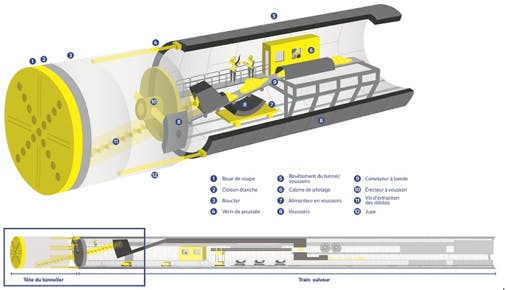
The tunnel boring machine is a powerful machine that is similar to an underground factory. With a total length of about 100 metres, it carries out both the excavation of the subsoil, the support of the land crossed and the actual construction of the tunnel, ensuring stability and watertightness. It is composed of two main parts: the shield and the following gear. The shield is used to dig (with the cutting wheel), to set up the segments (prefabricated elements that make up the final lining) and to extract the excavated material. At the rear of the bumper comes the following train, placed on rails. It is used to transport the segments from the outside, to control the tunnel boring machine and to evacuate the spoil to the entrance shaft which is the rear base of the tunnel boring machine.
Ancillary works
The technical structures, known as "ancillary structures", are essential for the proper functioning of the metro and the safety of passengers. They perform a variety of functions:
• Firefighter access allows the intervention of the emergency services,
• The ventilation structures ensure the renewal of the air in the tunnel and smoke extraction in the event of a fire,
• The rectifier stations supply electricity to the metro trains,
• The substations provide electricity to the stations and technical structures,
• The dewatering stations collect runoff water from the tunnel.
Technical works will be necessary; Some will perform several functions in order to limit costs on the one hand, and the duration of the work and the number of locations on the other, while ensuring quality architectural and urban integration.
The diaphragm wall construction method was chosen for the eight technical structures:
• Concrete diaphragm walls delimiting the contours of the future stations and structures are first put in place from the surface,
• Then the earth located between these walls is gradually extracted to the level of the platforms,
• Finally, the underground accesses and levels are created in the volume thus cleared.
The diaphragm wall method is particularly suitable for the construction of deep structures; It guarantees the waterproofing of the structures and the stability of the ground.