

ExtensionChâteau de Vincennes < > Val de Fontenay

The project
Why this project?
A dense, attractive and evolving territory:
- + 34,400 inhabitants(1) and + 30,000 additional jobs(1)(2) by 2040 in the sector, with a large share of new jobs in Val de Fontenay.
- These areas will remain residential and have few jobs in the Rigollots (Fontenay-sous-Bois, Vincennes) and Grands Pêchers (Montreuil) districts.
- Home-work trips are mainly oriented towards Paris with a high share of public transport.
(1) Vincennes, Fontenay-sous-Bois, Montreuil, and on the margin Neuilly-Plaisance, Rosny-sous-Bois.
(2) Paris XIIe, at the level of Château de Vincennes.
Neighbourhoods that would remain difficult to access:
- An isolation that would persist for the densely inhabited and poorly employed districts of Rigollots and Grands Pêchers despite the arrival of the T1 tramway, metro line 15 and the Bus Bords de Marne.
- A marked relief cuts the territory from east to west and complicates surface movements within narrow, winding and steep roads.
- A very dense local bus network , numerous lines, recently restructured and playing an essential role in feeder to transport hubs. Opportunities for meaningful improvement remain limited.
- Road congestion limits the efficiency of bus connections to metro/RER stations.
What are the objectives?
- Strengthen territorial equity, by offering the neighbourhoods served better access to employment and education centres and major facilities, in particular via the Val de Fontenay hub (RER and M15 by 2031).
- Support the development of the territory, by supporting the creation of housing and economic activity.
- Contribute to the ecological transition, by offering a reliable and inclusive alternative to the car for travel from suburb to suburb.
The benefits of the project
- A reliable, fast, comfortable and accessible link for the living areas served, to reach the employment centres of Paris and La Défense in particular, the university centres and the major facilities of the metropolis.
- A more robust public transport network in the east of the Ile-de-France region to facilitate travel from suburb to suburb, through a connection at the Val de Fontenay station-hub with the RER A, RER E, the many bus lines and the future Tram T1, metro 15 Est and Bus Bords de Marne.

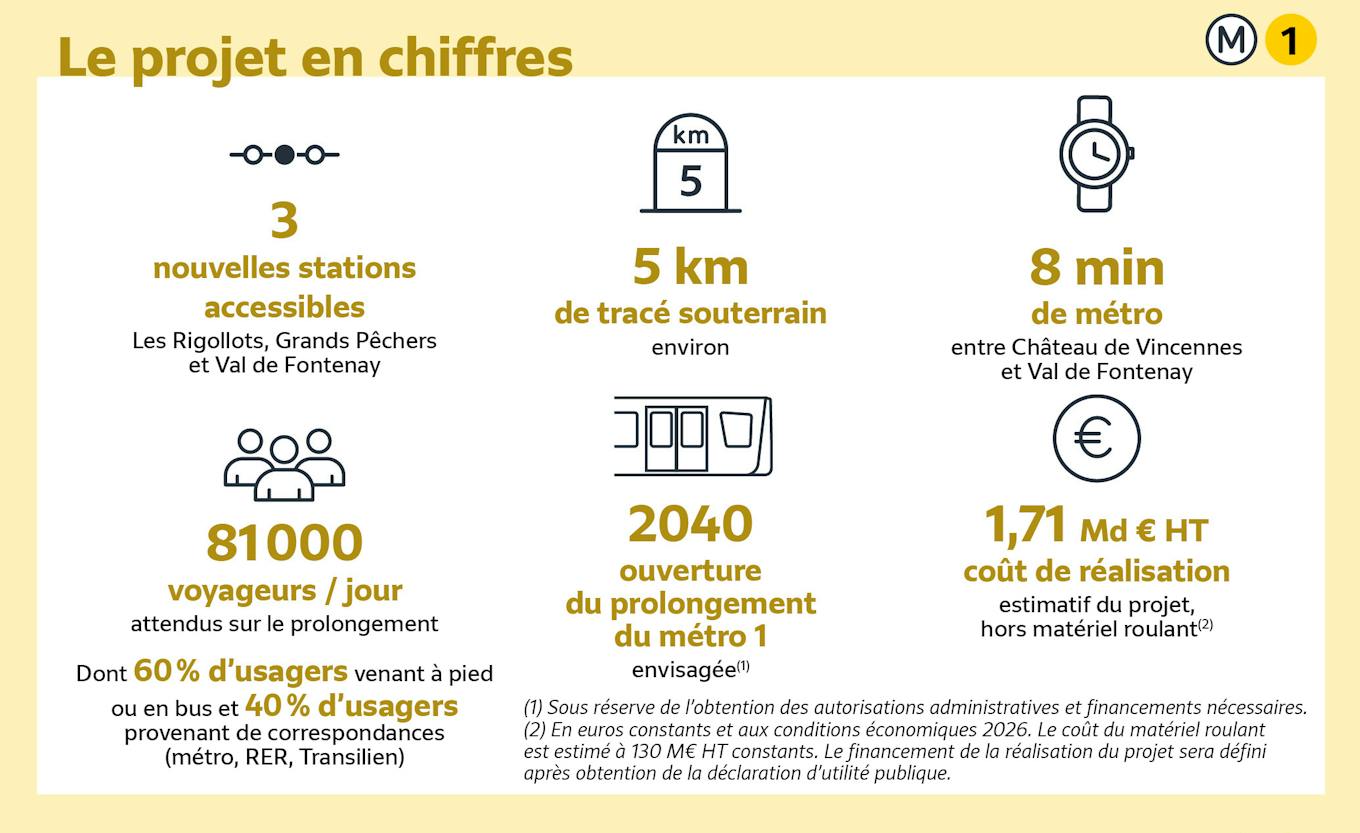
An improved project following the 2022 public inquiry
The lessons learned from this survey and the requests from the State have led Île-de-France Mobilités and RATP to deepen the studies and develop the project, particularly on environmental issues. This work aims to reduce the impact of the work, protect biodiversity, limit nuisance for local residents, imagine ambitious compensation measures, support the companies concerned and deepen geotechnical and hydrogeological knowledge
What's new in the project
- An up-to-date diagnosis of mobility needs
Changes in the territory (jobs, housing, transport) and travel needs have been updated and deepened. The resulting travel and socio-economic issues are the starting point for the definition of this transport project. - New variants of the project studied according to the Avoid, Reduce, Compensate approach:
-> For the connection to the existing infrastructures present in the Bois de Vincennes
-> For the stations
-> For the rear station and the train breakdown centre - Environmental studies to compare these new variants
- The order of magnitude of the cost of the project and its provisional schedule updated
- What if we did it differently?
Several alternatives to the metro project were studied and compared: the situation in the absence of a project (i.e. an improvement in the bus offer, without the development of new infrastructure), the tramway and the bus rapid transit system were the subject of a detailed analysis, with regard to the constraints of the territory and the travel needs to be met.
After the consultation, if the project continues with a view to a new public inquiry:
- A new environmental assessment
- The reestimated cost of the project and its new socio-economic assessment
- Continuous consultation under the aegis of guarantor(s)